
No party commissioned this post, and Dee2See isn’t affiliated with any of the brands featured in this section. These are independent, unsolicited suggestions, offered because the buying experience is worth thinking through out loud, not because anything here is broken. We know the tradeoffs, the stakeholders, and the resourcing reality behind every suggestion.
Functional mushroom drinks are having a moment: lion’s mane lattes, cordyceps energy shots, reishi everything, all riding the same wave of “coffee isn’t sophisticated enough for me anymore.” Magic Mind never joins that conversation. It’s branded itself into its own category, “mental performance shots,” built on nootropics and clinically-backed ingredients rather than adaptogenic wellness.
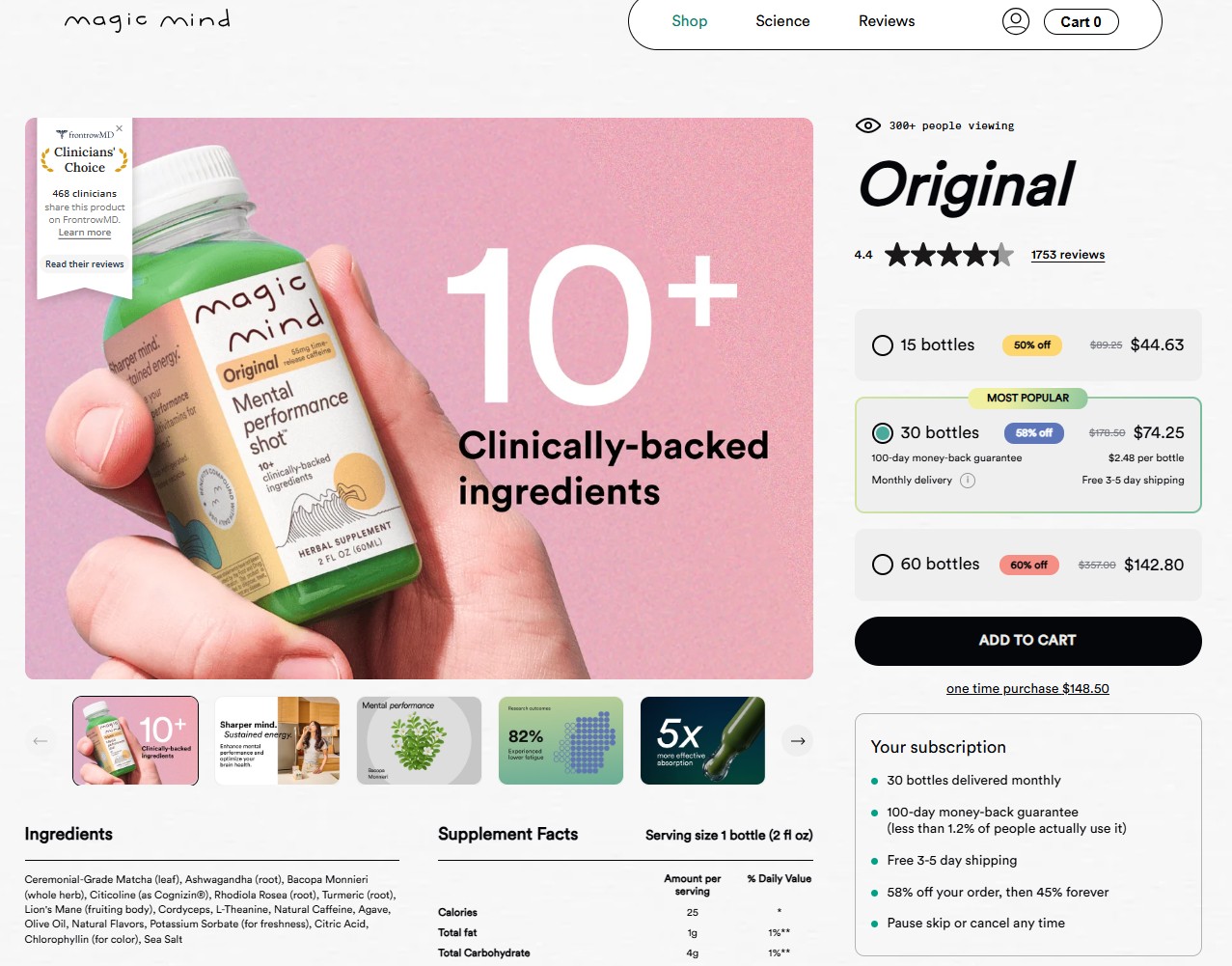
In a way, it seems like they have built the website entirely for shopping agents rather than humans. The desktop page has almost no typographic hierarchy: headlines, ingredient descriptions, legal disclaimers, and the subscription terms that actually decide the sale mostly render at the same small size, some of it down around 11px, the size usually reserved for footnotes, so a line as consequential as the guarantee stat ends up carrying the same visual weight as “Free 3-5 day shipping.” Nothing on the page tells the eye what actually matters, which is exactly how a line like that ships without anyone catching that it undercuts the sale.
What a First-Time Buyer Takes Away
A premium, credible-feeling nootropic shot. The page leans hard on specificity to earn trust fast: named compounds (Citicoline as Cognizin®, not just “citicoline”), a Day 1 / Day 7 / Day 30 progression that sets expectations instead of promising instant magic, a real athlete (Matthew Stafford, this year’s actual AP NFL MVP, confirmed) instead of a generic influencer, and a 100-day guarantee framed as literally risk-free (“no need to ship anything back”). The take-home feeling is “this is the science-y one, not the energy-drink one.” Price lands around $2.47 a bottle if you subscribe to the 30-pack, which reads as reasonable for the category.
What an AI Assistant Can Confidently Extract as Fact
Confident, structured facts: product name, $74.25 for 30 bottles (58% off a $178.50 list), 55mg caffeine, 2 fl oz serving size, full ingredient list (matcha, ashwagandha, Bacopa Monnieri, Cognizin citicoline, Rhodiola, turmeric, Lion’s Mane, cordyceps, L-theanine, natural caffeine, plus B/C/D vitamins), free 3-5 day US shipping, 100-day money-back guarantee with no return required, third-party PFAS/phthalate/bisphenol testing via LabProof (I checked, this is a real independent certifier, not a made-up mark).
Not confidently extractable as fact, only as “the brand claims”:
- Individual ingredient studies are real (Lion’s Mane/NGF, Rhodiola/cortisol, etc., linked to PubMed and Frontiers), but they test isolated compounds at isolated doses, not this specific blend as consumed. An agent citing “shown to enhance word recall” as a fact about this product would be overextending a citation about the ingredient in isolation.
- The “5x more effective absorption” nanoencapsulation claim has no citation attached at all, unlike the ingredient claims. It’s the one specific number on the page an agent has nothing to check it against.
- Subscriber count is inconsistent on the page itself: “over 30,000 monthly subscribers” near the testimonials, “over 32,000 monthly subscribers” in a footer image lower down. An AI assistant asked “how many subscribers does Magic Mind have” genuinely can’t give one confident number from this page alone.
What Is The Weakest Point

Not price, not caffeine, not even the subscription default. It’s this line, sitting directly under the Add to Cart button, at the exact moment of commitment:
“100-day money-back guarantee (less than 1.2% of people actually use it)”
That parenthetical is almost certainly meant to read as social proof (“people are happy, nobody needs refunds”). But read literally, at the one moment a buyer is actively weighing risk, it says: the safety net you’re relying on to say yes is one almost nobody manages to use. For anyone who’s been burned by a supplement subscription before, and in this category that’s a lot of people, that’s not reassurance. That’s the guarantee undercutting itself. It sits right next to a second friction point in the same bullet list, “58% off your order, then 45% forever,” which reveals the discount is a one-time teaser on a plan that renews at a lower but still-recurring discount. Together, in the same five-line block, the page manages to make its own guarantee look shaky and its own discount look like a trap, right where it needs the buyer most.
What to Do Tomorrow Morning
Instead of:
Your subscription
- 30 bottles delivered monthly
- 100-day money-back guarantee (less than 1.2% of people actually use it)
- Free 3-5 day shipping
- 58% off your order, then 45% forever
- Pause skip or cancel any time
Rewrite (using only facts already on the page):
Your subscription
- 30 bottles delivered monthly
- Pause, skip, or cancel any time
- 58% off your first order, 45% off every order after that
- Free 3-5 day shipping
- 100-day money-back guarantee, no return required
What changed and why:
- Cut the redemption-rate stat entirely. I didn’t spin it into “98.8% satisfaction,” that’s a logical leap the page doesn’t support. Not requesting a refund isn’t the same as loving the product. It’s the same kind of unearned inference Lihi’s own Dee2See rule cuts on sight.
- Moved cancel-anytime under the delivery bullet, so the recurring commitment and the escape hatch appear in the same breath instead of the reassurance being buried at the bottom of the list.
- Stated the discount structure plainly instead of tucking it in as one bullet among five. Buyers need this before they click, not as fine print. Surfacing it clearly is the more trustworthy move, not a softer one, and it uses the same numbers already on the page.
- Pulled “no return required” from the page’s own 100-day trial section lower down, so the guarantee is stated the same way twice instead of getting a weaker, self-doubting
Second Opinion, Dee2See’s unsolicited sibling, gives brand managers and growth teams free buying-experience notes on stores we weren’t hired to look at. We noticed something. We’re not billing anyone for saying so.
Got a product page you want taken apart like this? Send it over to hi@thespetz.com. Second Opinion runs on real pages, not hypotheticals, and I’ll tear yours apart the same way, in public, for free. No hard feelings if the answer turns out to be “nothing wrong here,” though that hasn’t happened yet.


