
Most menswear brands treat the checkout journey like a corporate catalog. They pick a clean, neutral template, write generic product descriptions about “premium comfort,” and list standard fabric compositions. They optimize for a polite, frictionless transaction.
Chubbies does not play by those rules.
Founded in 2011, Chubbies built an entire empire by weaponizing a simple, rebellious premise: men’s shorts had grown way too long, too boring, and too serious. They didn’t just scale a brand; they engineered a loud, retro-fueled subculture centered entirely around the 5.5-inch inseam.
But you cannot build a lasting, multi-million dollar direct-to-consumer powerhouse on funny social media memes alone. Behind the neon prints and rowdy weekend aesthetic lies a brilliant, highly intentional conversion system. Chubbies seamlessly weaves behavioral psychology, seamless promotional layout strategy, and unapologetic brand voice into a unified ecosystem designed to demolish consumer doubt and maximize average order value.
The Power of Body Inclusivity

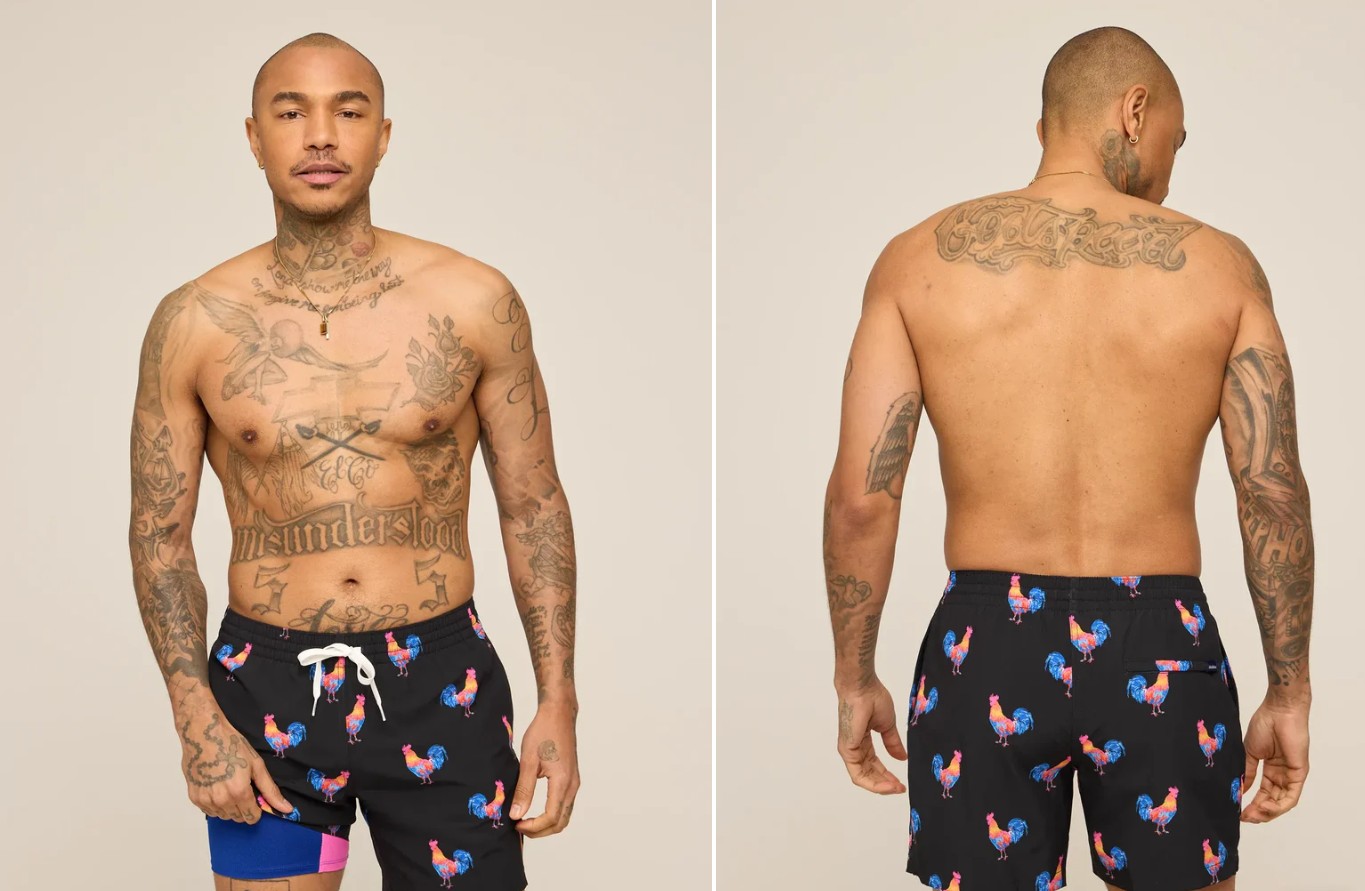
Chubbies constructs immediate customer empathy on their Product Listing Pages (PLPs) by showcasing real, diverse body types. You don’t see carbon-copy, heavily airbrushed fitness models. Instead, you see men with a massive range of shapes, heights, and builds standing naturally.
The staggering variety of real-world photography style might be a hyper-calculated strategic choice, or it might simply be a practical mix-and-match of assets from different studio and packshot shooting days. Regardless of the operational origin, the systemic outcome is pure conversion gold. It strips away the hidden, silent anxiety of “Will this look ridiculous on me?” The user instantly finds a model that mirrors their own build, transforming an intimidating apparel choice into an easy, comfortable reality.
This visual reality provides a massive lesson for brands currently re-engineering their photography pipelines around artificial intelligence. If you are creating your model photoshoots on AI, the ultimate conversion trap is perfection. Generative AI naturally defaults to flawless, highly symmetrical, identical human structures—which is the exact recipe for consumer detachment and high return rates.
True conversion-driven AI generation means explicitly programming imperfections, varied body structures, realistic skin tones, and non-standard physical builds into your prompt models. If your digital avatars look like a perfect algorithm instead of a real person, your customers will look at your product with immediate subconscious distrust.
Another thing about the PLP, though not itensive (I think) – the fact that the product images aren’t all the same, some of them are models shots, some product shots. Maybe it’s because that’s what they had on their visual inventory – but this layout break acts as a massive attention hook. Introducing a sudden styling anomaly in the middle of a continuous grid of bare torsos forces your wandering eyes to stop, register the change, and lock onto their lounge apparel. It drives cross-category product discovery without utilizing annoying pop-ups or desperate banners.
The Power of Naming
Most apparel brands name their garments based on a predictable, cold description of the material. You get names like “Men’s Stretch Khaki Short” or “Casual Striped Denim.”
Chubbies looks at that commodity trap and blows it up. They understand a core behavioral rule: when you name a product like a commodity, you invite price comparison. If your short is just a “Khaki Short,” the user’s brain immediately cross-references the price with Amazon, Target, or Old Navy.

To break this comparison loop, Chubbies uses naming as a primary vehicle for identity placement and emotional connection.
You aren’t browsing plain tan shorts; you are choosing “The Khakinators“, the “Domingos are for Flamingos” or “The Disco Plums“. These names remove the garment from a basic clothing category and plant it firmly into an entertainment and lifestyle category. The name gives the customer an internal identity to latch onto, making the item feel like a collector’s piece rather than just another basic piece of clothing. Oh how I’d wish I could be part of their product naming team! (And paint colors’ as well!!)
Show the Spec, Sell the Sensation
Selling online with a massive, inherent hurdle: the customer cannot physically touch the product, whether it’s a fashion, furniture or food item. In this case, he can’t feel the fabric, feel the stretch, or test the support of an interior liner. Chubbies handles this sensory gap by using highly targeted, full-bleed micro-photography to visually demonstrate physical utility.
On Chubbies’ product page second scroll strip, the left half of the panel features a massive, zoomed-in shot of a hand actively pulling and stretching the built-in, anti-chafing compression boxer brief liner underneath a pair of swim trunks. The rotating overlay text displayes the product’s features.
The right side of the panel displays a tight macro shot of the pattern fabric bunched and folded, showing off its physical weight and construction along with the text that combines technical specifications with an immediate sensory benefit hook to capture both the rational and emotional brain. While most apparel brands simply list a raw fabric blend and leave the customer to guess the physical outcome, Chubbies actively bridges the gap between cold manufacturing data and pure human feeling.

Swatch Sorting
When an apparel brand drops dozens of wild prints, vibrant solids, and classic stripes, the primary conversion threat shifts from “lack of interest” to choice paralysis. When faced with an absolute wall of colorful options, the consumer’s brain stalls out, overwhelmed by the mental energy required to evaluate every individual design.
Chubbies enable the customer to see all prints and swatches, but also click pre-filtered buttons to see specific options. This simple feature enables the customer who knows they want a loud pattern can filter out the solids immediately; a user looking for a tamed-down stripe can isolate their choices in a single click. By letting the shopper filter down a chaotic universe of variants into bite-sized, thematic sub-categories without ever reloading the page, Chubbies clears out the visual noise.

Product Page Agentic-Commerce Readiness
Chubbies’ vivid, personality-driven approach to language isn’t just about being witty for human readers. It is a highly strategic layout choice that makes Chubbies’ product detail pages uniquely prepared for the emerging world of AI-driven commerce, semantic search, and personalized shopping assistants.
When AI search engines and conversational shopping bots crawl a product description to evaluate who an item is built for, they don’t just count keywords. They look for specific behavioral cues, environmental context, user intent, and lifestyle indicators. Chubbies packages this data up beautifully on a silver platter in their product descriptions.
Look at the structured copy layout and how it translates into pure data value for automated systems:

- Product Details Section: “…Refined to be even better… Your comfort and confidence are guaranteed to be thigh-high.” This immediately establishes the core product mission and fit category for semantic indexing.
- Pockets Microcopy:“Oxford lined side pockets, two back pockets big enough for the largest of iPhones (or Androids, green texts we see you)…” This is much more than a simple bullet point about storage space. By utilizing sharp, laugh-out-loud humor, they answer a real-world utility query while calling out a common cultural pain point. It transforms standard, boring hardware specs into a witty piece of entertainment that forms an immediate connection with the consumer.
Explicitly isolating a “Best For” section packed with real lifestyle situations like tailgating and happy hour makes their data highly scannable for semantic AI algorithms. If a consumer asks a personalized AI assistant to “Find me a pair of casual stretch shorts perfect for a sunny outdoor tailgate,” a standard apparel page with generic material specs will get filtered out.
Chubbies’ structured layout, however, ensures their product matches that exact search vector instantly. They are designing their language from the core components outward, ensuring their brand voice serves dual purposes: human emotional conversion and automated platform discovery.
Fitting Cues
I’m not sure that this was done in purpose as well, but take a look at this model showing three inseam lengths. Notice the palm tree tattoo on his thigh. This looks like an organic byproduct of model casting rather than an intentional UX feature planned on a wireframe, yet it serves as a brilliant physical benchmark.

The placement of the ink acts as an accidental guide, showing you exactly where the short rides on an active body. It proves the 5.5-inch inseam length better than any cold sizing chart ever could, leaning perfectly into the raw, weekend-warrior brand narrative.
Instead of forcing the user to mentally calculate what an abstract number means, the interface uses human context to give an instant sense of proportion. The consumer doesn’t have to leave the page or guess the fit – they look at a permanent marker on a real leg and get immediate visual validation.
The Fabric Filtering Missed Opportunity
While the visual pattern filter does a brilliant job handling the aesthetics, the master slide-out navigation menu presents a textbook opportunity to optimize mechanical friction.

The technical fabric list creates a subtle gap in clarity. A customer looking at Resort Weave or Breezetech has no immediate way of knowing what those materials feel like, how thick they are, or if they are meant for a pool deck or a golf course.
To turn this potential point of confusion into a seamless conversion driver, Chubbies could upgrade these filter nodes with educational micro-interactions. Adding quick informational tooltips directly adjacent to the checkboxes would guide users through the physical properties of the materials.
For example,“Breezetech: Ultralight, perforated, sweat-wicking knit built for high-heat golf days“, or Resort Weave could say: “Resort Weave: Structured, ultra-breathable linen alternative that resists wrinkles at dinner.” This small system upgrade would prevent users from guessing incorrectly, protecting post-purchase trust and lowering overall return rates.
Circular Commerce and the “Cheekies” Brand Experiment
True product thinking means knowing how to scale a core brand DNA into secondary revenue streams—and identifying when an experiment is still finding its footing.
Chubbies launched a women’s swim and apparel line called Cheekies which is quite far from the Chubbies’ brand tone of voice and website features. a “For Her” category appears on Chubbies navigation bar, and when clicking it, a separate brand website opens, built on what seems like a basic Shopify template.
Cheekies currently lacks the explosive humor, rowdy identity positioning, and rebellious visual hooks that made Chubbies an industry giant, and I’m wondering if it’s in a lean testing mode. Before investing millions into re-engineering an entire subculture, writing thousands of lines of high-risk copy, and building bespoke visual assets for a completely new demographic, the brand is running an MVP to test the market demand, tracking baseline conversion rates, and gathering raw data to see if the female consumer segment is worth a full-scale, highly differentiated brand investment.

On the other hand, Chubbies’ resale ecosystem is a fully realized retention engine. I love seeing recommerce done well. Instead of treating customer trade-ins like an unwanted operational burden or running it through a dry, clinical marketplace integration, Chubbies wraps the entire pre-loved exchange in an exclusive community identity called the “Chubbies Afterparty.”
Even the naming is brilliant. It transforms the act of users selling back their old gear into entering an exclusive circle of trust where they feel like true brand insiders. This program feeds directly into customer lifetime value via an incredible financial trade-in, offering an unprecedented 110% bonus store credit when customers sell their old Chubbies products back to the brand keeps the community locked into their ecosystem indefinitely. It turns what could be a forgotten pair of shorts in a closet into a powerful engine for circular revenue and unshakeable customer retention.
The Takeaway
Chubbies proves that high-converting digital storefronts aren’t built on sterile, isolated best practices. True commerce optimization requires treating UX, consumer psychology, and strategic storytelling not as separate siloed channels, but as one singular system. Winning digital design means aligning user psychology, business constraints, and precise execution into an undeniable flow that systematically guides a human being from deep skepticism straight into a final purchasing decision.
Deploy real-world visual cues to collapse the sensory gap: Never rely entirely on text blocks or dry size guides. Embed live proportions, scaling ratios, and physical material markers directly into your primary assets-like showing fabric elasticity under tension or utilizing organic body anchors to prove a fit. Let the user visually feel the outcome through the glass.
Vary your layout grids to spark discovery: Avoid visual boredom on your listing pages. Introduce diverse model types and subtle layout variations across your product rows to catch the eye and highlight secondary item lines naturally.
Weaponize humor and bespoke naming (when relevant) to destroy commodity logic: Do not let your products look like an easily replaceable manufacturing catalog. Inject witty copy and highly differentiated product names to strip away baseline price sensitivity and turn a standard transaction into a premium lifestyle discovery.
Structure your descriptions for AI discovery: Don’t write plain, blocky paragraphs. Organize your product details with clear situational tags like “Best For,” ensuring your pages are fully optimized for personalized AI shopping assistants.
Dee2See by Lihi Lothan reviews DTC ecommerce experiences for brand managers and growth teams. We look at what happens between “I’m interested” and “I bought it.”


One response to “Behind the Seams: Chubbies”
[…] a look at how Chubbies deal with multiple swatches […]